Archive for the Category ◊ How To ◊

• Monday, May 06th, 2013

Not sure about you, but we’ve been pretty busy here at Orlando Bonsai so far this spring.  Filling orders, doing paperwork and tax reports, preparing soil.  Re-doing the pond, weeding, trimming trees. Fertilizing, insect maintenance, acquiring new trees, selling trees. Attending bonsai meetings, demonstrations and garden shows, visiting suppliers, and volunteering at Epcot’s International Flower & Garden Show.  Help, I need a time out! Of course, there was National Grilled Cheese Day, and a mini time out for a grilled cheese lunch. Yummy! And we did go see a movie – another mini time out. That was fun!

Have you been busy? Need a time out too?  Come join Orlando Bonsai from May 24 – 27 at the 2013 Bonsai Societies of Florida (BSF) Annual Convention to be held in sunny Lake Mary, FL at the Mariott. It will feature bonsai artist, Suthin Sukosolvisit with Sean Smith and Michael Feduccia teaching workshops and demonstrations. Orlando Bonsai will be selling bonsai tools and supplies in the vendor area.  And also check out the Exhibit area for a beautiful display of bonsai by many Florida artists. For more info, go to the BSF web site, www.bonsai-bsf.com.

…Back to working in the bonsai garden. The fastest ways to a great bonsai:  start with good stock, take a good look at the roots, pick a front, pick the apex (top of tree), cut the correct branches, trim hard – trim early, proper maintenance, trim new growth, and pay attention! Nutshell version:  do the right things at the right time! How do you know what the right things are?  1. Education. Read a book, join a club, go online, ask questions, find a mentor, take a class. 2. Experiment scientifically.  For example, cut a secondary branch, take a picture, journal it (date, tree name, photo, notes, etc.) wait for new growth, see where the new growth occurs, look back at your picture to see the difference.  Soon you will learn the growth habits of that tree. By the way, the fastest way to a great bonsai takes time. Is that an oxymoron? Or just buy a good-looking tree in a pot and then maintain it. That’s pretty fast! Either way, it is worth it.

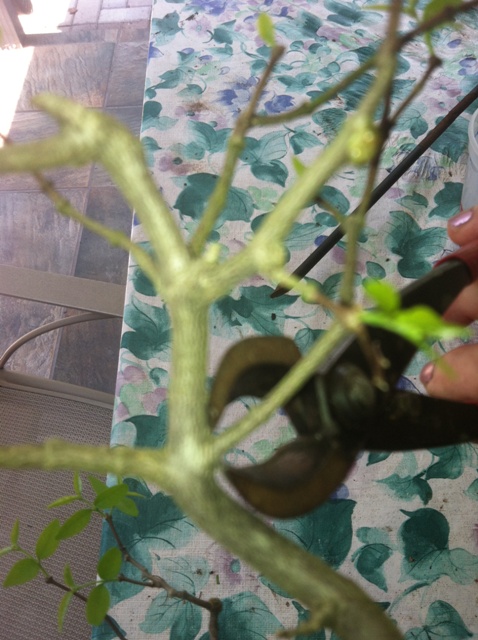
Aspiring bonsai enthusiasts often ask “How do I know which branch to cut”? Well, it takes a little time and sometimes a mistake or two, but there are some general guidelines to help.  If a branch is growing straight down, typically you would cut it off. If a branch is growing on the inside curve, it should come off.  Look at the picture of the branch I took off with standard concave cutters from an inside curve. It’s a little fuzzy but you can get the idea. Another guideline is to avoid bar branches – branches directly across from each other. Notice the branch I was about to cut off was also a bar branch and there is another branch directly above it that has secondary bar branches so I cut one of them off too. There are other guidelines to learn as you go.
Inside Curve cut

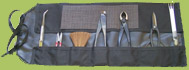
The right tool is needed for the right job. Four tools I use all the time are standard concave cutters, shears, wire cutters and tweezers. And there are lots of other great tools that really come in handy and some that are more specialized. Feel free to send an inquiry to sandy@orlandobonsai.com if you are unsure what tool is needed or how to use it.

So take a TIME OUT! After ‘working’ in the garden, get a refreshing beverage of your choice,  sit back and ENJOY your bonsai.



• Friday, March 08th, 2013

Winter is almost over!  There was almost no winter here in Florida so our trees haven’t had much rest.  Even the citrus is confused, but bonsai enthusiasts, tourists and snowbirds are loving it. Yaay! Come on down (or up or over or whichever direction is appropriate) because Walt Disney World’s 20th annual Epcot Flower and Garden Festival, presented by HGTV, runs for 75 days from March 6–May 19, 2013. And members of the Central Florida Bonsai Club, are once again at the Festival Center, the Wonders of Life building (the one with the golden dome near the Test Track), displaying bonsai and answering the guests’ questions about bonsai.  I will be there on March 9 and several other times throughout the Festival. Check out Orlando Bonsai’s Facebook page frequently for upcoming pix that I will take this year. At Epcot, where people visit from around the world, it is easy to feel a connection with everyone through the shared love of plants and bonsai.

Last month, I had the privilege to attend a Deciduous tree workshop at D & L Nursery near Ocala where Owen Reich shared information and demonstrated skills learned as an apprentice at Fujikawa kouka-en in Osaka, Japan.  Owen stressed that it takes time to create the “perfect” tree.  He talked about how important it is to look for a good trunk as it is the hardest thing to change on a bonsai. Owen also encouraged us to make large cuts on trees over time so they will heal faster and not stress the tree.  Making a lot of major cuts on the tree in the same year is not good for the health of the tree.  He said you will have a better looking tree in the long run by using this method. The goal is to not even know that the branch was cut.  He also talked about wiring the roots which happens all the time in Japan but not so much in America. He demonstrated wiring branches using a ‘rhythmic wrap’ while introducing movement – up, down, left and right. There were many little tips and tricks that Owen shared along the way as he demonstrated using each participant’s trees.  I really encourage you to attend any event where Owen is teaching; he has a ‘laid back’ style and shares a lot of information as he goes. He plans to go back to Japan in a few years to continue his studies.

In February I went for a walk in nearby Fleet People’s park where old live oaks abound and dogs too. It’s a dog park so if you visit, be prepared for them to be running free. They are very social and love their park. It’s a fenced-in lakeside park and has a war memorial walk nearby and connects to a walking/bike path that goes for miles. If you want to see the pictures of the most amazing movement in the branches of these old oaks, look for the pictures on our Facebook page. I promise it will be worth clicking on the link! These pictures are my reminders as I try to emulate their aged look into my bonsai trees as I am wiring branches.

As you are looking for your spring bonsai supplies, if there is something you are looking for and don’t see it in Orlando Bonsai’s store, let us know as it is likely we can find it at one of our suppliers if we really don’t have it.  We always have trees and supplies that aren’t displayed on the site yet. As always, we welcome your feedback.

Speaking of Spring, remember to spring forward 1 hour as Daylight Saving Time starts in the USA & Canada this Sunday, March 10, 2013 at 2:00 am.

Enjoy bonsai!


• Friday, August 31st, 2012

As TS/Hurricane/TS Isaac is still hammering the Mississippi Delta and our thoughts and prayers are with all those affected, it makes us think of the ravaging effect nature can have on people and their environment including trees.  When Hurricane Charley hit our neighborhood in our city in Central Florida, over 400 oak trees were down. It was a strange time having no water or electricity for days and having to chop and move fallen trees to get to the main road. For months and years later, the remaining trees were affected.  Most had their leaves blown right off and at their rebirth the leaves were so close to the huge branches – just like after we do a hard chop on a bonsai. A trip to Georgia and seeing the lush, green leafy trees reminded me of how much our landscape had changed.  But ultimately, secondary and tertiary branching happened and the trees’ leaves filled out and normalized.  Then new trees were planted and we compared their upright branches to the downward, heavier, gnarly branches of the older trees that seemed much more aged after the storm. Bonsai!  That’s the look I had been trying to achieve.  All we have to do is look around and emulate what we see.  Easy, right?

I started paying more attention and was encouraged in a Peter Warren Chinese Elm workshop in May to wire correctly all the time. Then in July at Tropical Bonsai School, I noticed that some of the best-looking trees were older trees that had been gifted or inherited from older club members.  They had substantially more movement in the branches - natural aging.  Wiring, care & time had combined to create trees worthy of exhibit display.  The significance of wiring became very clear, proper wiring, that is.  Also key is to remove the wire at the right time – not too soon, not too long.  Like a clay sculptor, with passion we sculpt our trees with wiring and carving to create our ‘masterpiece’.  Also, like a painter or sculptor, practice, practice, practice paves the way to the finest works of art.  I’m still a fan of ‘clip and grow’ for some tropicals that aren’t conducive to wiring, but when there is opportunity wire will improve the trees faster and better.  Take a look at the Wiring Techniques video on Orlando Bonsai and tomorrow when you’re in the bonsai garden or at the next bonsai exhibit, take a new look at the trees with only wire and branch movement in mind.  Then, as always, take action when the time is right!

Majestic old live oak tree
( at the Enzian Theatre looking out from the Eden Bar)


Author:
• Sunday, August 21st, 2011

It feels like forever since I have posted on Orlando Bonsai. I have been creating instructional bonsai videos and it has pretty much taken all of my free time to do. However I want to get get back to updating my site with still pictures of my trees so that I can capture the progression of their development. Hopefully in the next couple of weeks aI can get my trees cleaned up enough to do some nice shots.

The following video shows the steps I take to redefine my trees and get them better looking every year.